Buying guide
Best golf rangefinder: how to choose a laser rangefinder
How to choose the best golf rangefinder: range to the flag, flag lock, magnification, slope and the Rules of Golf, battery, weather and use on the course.
The best golf rangefinder for most club golfers is one that picks out the flag quickly, is easy to hold steady and has a plain distance mode you can use in any competition. The headline range figure and the extra modes matter less than they look on the box. This guide explains each feature in plain terms, what the Rules of Golf allow, and how to get a number you can trust on the course.
How a laser rangefinder works
A laser rangefinder sends out short pulses of invisible infrared light and times how long they take to bounce back from the target. From that time it works out the distance. You look through the eyepiece, put the aiming mark on the flag, press the button and read the number in the display.
Because it measures to whatever the beam hits, a laser needs a clear line of sight. If you cannot see the flag, you cannot range it. A GPS watch or app works in a different way, and our guide to golf rangefinder vs GPS watch compares the two.
Range: the box figure is not the range to the flag
The maximum range printed on a rangefinder is usually measured to a large, reflective target. A flag is thin and does not reflect much, so the range to a flag is shorter. One well-known maker's manual lists about 594 m (650 yards) to a reflective target, 548 m (600 yards) to trees and 274 m (300 yards) to a flag for the same unit.
Makers' manuals also list what reduces range: a dark or dull target, a small target, haze, fog, rain and bright sunshine, especially when you range towards the sun. For golf, a solid reading to a flag from approach distance is what counts.
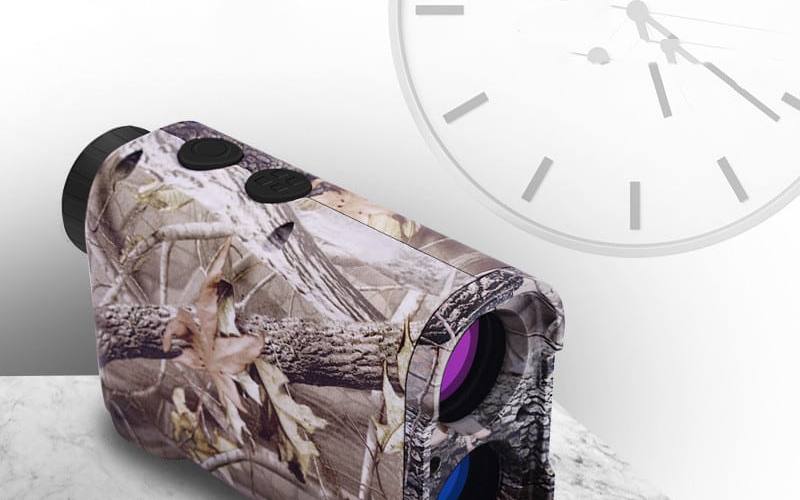
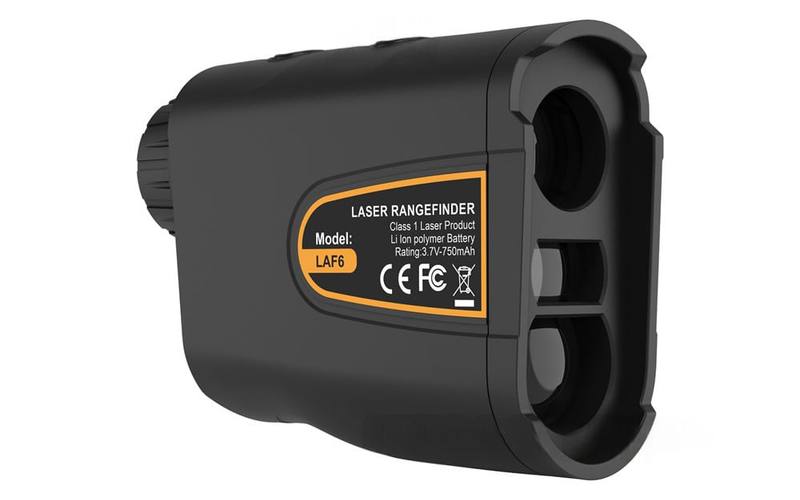
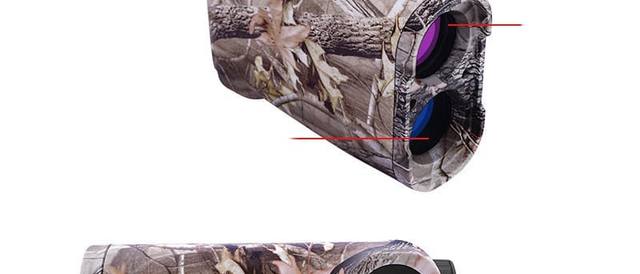
Our golf laser rangefinder with flag lock measures from 5 to 600 m. As with any laser, expect a shorter reach to a flag. For our rechargeable LAF6 rangefinder, the supplier does not give the range of this model on its own, only for the whole LAF series, so email us if you need the figure.
Accuracy
Golf rangefinders commonly quote accuracy of about plus or minus 1 yard or 1 m. Our 600 m model is listed as accurate to about 1 m. The supplier does not state the distance accuracy of the LAF6.
In practice, the bigger error is hitting the wrong target. A reading to the trees 20 m behind the green is perfectly accurate, and no use at all. That is why flag lock matters more than the accuracy figure.
Flag lock and vibration
Flag lock goes by many names: pin seeking, first target priority, target lock. The idea is the same. When the beam hits the flag and the trees behind it, the rangefinder shows the distance to the nearer object, which is usually the flag. To use it, hold the button and sweep slowly across the flag so the beam catches it.
Many rangefinders confirm the lock with a short vibration, a flashing ring or a symbol in the display. A vibration is the easiest to notice, because you feel it while your eye is still on the flag.
Our 600 m rangefinder has a flag lock mode, with no vibration alert, so you watch the display for the lock. The supplier does not list flag lock for the LAF6.
Magnification and optics
Magnification makes the flag look closer, so the aiming mark is easier to hold on a small target. 6x is the usual figure for golf rangefinders, and a few premium models offer 7x. Both of ours are 6x. The front (objective) lens gathers light: it is 25 mm on our 600 m model and 21.8 mm on the LAF6.
Slope, angle readings and the Rules of Golf
A slope function measures the angle up or down to the target. Some rangefinders then show a "plays like" distance, longer for an uphill shot and shorter for a downhill one. It is useful in practice, but the Rules limit it.
- Rule 4.3a(1) allows you to get information on distance or direction from a device. It does not allow measuring elevation changes, or a device that interprets the distance for you, such as suggesting a club.
- Rule 4.3 is about use, not ownership. It does not limit the equipment you carry. A rangefinder with a slope or angle mode is fine in a round under the Rules, as long as you do not use that mode.
- Model Local Rule G-5 lets a committee ban electronic distance-measuring devices for a competition. Check the Local Rules before you tee off.
- Penalty. A first breach of Rule 4.3 costs the general penalty: two strokes in stroke play, or loss of the hole in match play. A second breach means disqualification.
Both of our rangefinders read angles. Leave the angle reading off in any competition round, and in any round you submit for your handicap, because those rounds are played under the Rules of Golf. The same Rule 4.3 also stops you using training aids during a round, which our golf swing trainer guide explains.
Battery: CR2 or rechargeable
Many golf rangefinders take a 3-volt CR2 lithium battery. You can swap a flat one in seconds on the course if you keep a spare in the bag, but you have to buy replacements. A rechargeable rangefinder charges from a cable, so there is nothing to buy, but if you forget to charge it there is no quick fix halfway round.
Our 600 m model takes a CR2 lithium battery, and one is listed in the box. The LAF6 has a built-in 750 mAh battery and a charging cable in the box, and it switches itself off after 12 seconds without use to save power.
Size, weather and carrying
A rangefinder lives in a pocket or a pouch on the bag, so size matters. The LAF6 measures 96.5 x 63 x 35 mm and the 600 m model 104 x 70 x 37 mm. The 600 m model comes with a carry case, a hand strap and a carabiner for clipping it to the bag.
For wet weather, look for an IP rating. A second digit of 4 (IPX4) means protection against water splashed from any direction. A 7 (IPX7) means protection against temporary immersion between 15 cm and 1 m for 30 minutes. The supplier does not give a water resistance rating for either of our rangefinders, so keep them in a pocket or the case when it rains and let them dry indoors. The LAF6 is listed for use from minus 10 to 40 degrees C.
How to use a rangefinder on the course
- Pick your units. Set metres or yards to match how you know your club distances.
- Hold it steady. Use both hands and tuck your elbows in, or rest your hands on the trolley.
- Sweep the flag. Aim just beside the flag, hold the button and move slowly across it until the lock shows.
- Check the number. If it is far longer than you expected, you probably hit the trees. Try again.
- Be ready on time. Take your reading while others play. Rule 5.6b recommends making your stroke within 40 seconds once it is your turn and you can play.
- Stay safe. Never point the laser at people, animals or vehicles, and never look at the sun through the eyepiece.
Which of our rangefinders suits you?
| Feature | Flag lock, 600 m | Rechargeable LAF6 |
|---|---|---|
| Measuring range | 5 to 600 m | not stated for this model |
| Accuracy | about 1 m | not stated |
| Flag lock | yes, no vibration | not stated |
| Magnification | 6x, 25 mm lens | 6x, 21.8 mm lens |
| Angle reading | minus 60 to plus 60 degrees | minus 90 to plus 90 degrees |
| Power | CR2 lithium battery | built-in 750 mAh, charging cable |
Both are budget rangefinders. Premium models add features such as a vibration on lock, an IPX7 rating or a slope switch with an outside indicator, and they cost more. For a club golfer who plays most weekends, the 600 m model with flag lock is our pick. The LAF6 suits a golfer who would rather charge than buy batteries, and who accepts that the supplier gives fewer figures for it.
See both on our golf rangefinders page. If you are buying one as a present, our gifts for golfers guide has a few more ideas.
Frequently asked questions
Can I use a rangefinder with slope in a competition?
You can carry it, but you must not use the slope or angle function. Rule 4.3a(1) of the Rules of Golf allows distance information from a device and does not allow measuring elevation changes. Rule 4.3 is about how equipment is used, so a device with a slope mode is fine if that mode stays off. A committee can also ban distance-measuring devices altogether with Model Local Rule G-5, so read the competition's Local Rules first.
Do I need a rangefinder that vibrates when it finds the flag?
No, but it helps. A short vibration or a flashing ring tells you the reading came from the flag rather than the trees behind it, without looking twice. On a model without vibration you read the lock in the display instead. Either way, a reading far longer than you expected usually means the laser hit something behind the green.
Can I tell my playing partner the distance from my rangefinder?
Yes. Under the Rules of Golf, the distance from one point to another is public information, not advice, so you can share it freely. What you must not do in a round under the Rules is use a function that measures elevation or turns the distance into a club suggestion.
What is the best golf rangefinder for a beginner?
A simple one. A beginner needs a clear distance to the flag, a flag lock mode and a battery that is easy to replace or charge. Extra modes add buttons to learn and often cannot be used in competitions anyway. Spend the effort on learning how far each of your clubs carries, so the number on the display means something.