Comparison
Golf rangefinder vs GPS watch: which one do you need?
Laser rangefinder or GPS rangefinder watch? How each measures, pin vs front, middle and back, hazards, battery, the Rules of Golf and who should pick which.
A laser rangefinder gives you the exact distance to whatever you aim it at, usually the flag, as long as you can see it. A GPS watch, handheld or phone app gives you distances to the front, middle and back of the green and to mapped hazards from anywhere on the course, without aiming. If you want the exact number to the pin, pick a laser. If you want the layout of holes you cannot see, pick GPS. Plenty of golfers use both.
How each one measures
A laser rangefinder sends short pulses of invisible infrared light at the target and times how long they take to come back. The distance is to the object the beam hits, so the laser needs a clear line of sight.
A GPS rangefinder, whether a watch, a handheld unit or a phone app, works out where you are from satellite signals. It then compares your position with a map of the course stored in the device or the app, and shows the distance to points on that map. It does not need to see anything, so it still gives a number from the trees, from behind a hill or round a dogleg.
That difference explains almost everything else in this guide.
The pin, or the green?
A laser measures to the flag where it is cut today. On a deep green, the gap between a front pin and a back pin can be more than a club, so the exact number matters most on approach shots.
A GPS device usually shows the front, middle and back of the green. In most cases it does not know where today's flag is, because the flag position is not on the map. The front and back numbers are still useful: they tell you how much green you have to work with, and the safe number to cover the front.
| Laser rangefinder | GPS watch or app | |
|---|---|---|
| Distance to the flag | exact, if you can see it | no, only front, middle and back |
| Blind shots | no | yes |
| Hazards and lay-ups | only those you can see | mapped ones, at a glance |
| Course map | not needed | needed, and must be correct |
| Subscription | never | on some apps and devices |
| Power | battery or charge, used in short bursts | GPS runs all round |
Hazards, doglegs and blind shots
GPS is strong on the things you cannot see. From the tee it can show the distance to carry a bunker, to reach the water and to lay up short of a ditch, all without aiming at anything. On a blind second shot over a hill, it still gives you a number.
A laser can range a bunker face, a tree on the corner of a dogleg or the edge of a pond, but only if you can see it and pick it out. If trees or a hill block your view of the target, it cannot help.
Course maps, updates and subscriptions
A GPS device is only as good as its map. If a course has new tees or a rebuilt bunker, or was mapped badly in the first place, the numbers will be wrong, and you cannot check them yourself. Keep the device and its course maps up to date, and check that the courses you play are covered before you buy.
Winter is another catch. When a hole plays to a temporary green, the GPS map usually still shows the normal green. A laser simply ranges the flag in front of you. Our guide to practising golf at home in winter has more on getting through the UK winter.
Some golf GPS apps and devices keep features behind a paid subscription. Basic green distances are often free, while hazard distances, plays-like numbers or club suggestions can cost extra. A laser has no maps, no updates and no subscription, and it works the same on a course that has never been mapped and on the practice ground.
Accuracy
GPS accuracy depends on two things: the satellite fix and the map. GPS.gov, the US government's GPS information site, says GPS-enabled smartphones are typically accurate to within a 4.9 m (16 ft) radius under open sky, and that accuracy gets worse near buildings, bridges and trees. Watches and handhelds vary by model.
A laser's figure is simpler. Golf rangefinders commonly quote about plus or minus 1 yard or 1 m, as long as the beam hits the flag and not the trees behind it. That is why flag lock matters on a laser.
Battery
A laser only fires for a moment each time you press the button, and many switch off after a few seconds. Some take a CR2 battery you can swap on the course, others charge from a cable.
A GPS watch keeps tracking your position for the whole round, so it needs charging before you go out. A phone app tends to drain the phone's battery heavily over 18 holes. If the phone is also your scorecard or your emergency contact, take a power bank.
Speed of play
Rule 5.6b of the Rules of Golf asks you to prepare for your next stroke in advance and recommends playing within 40 seconds once it is your turn. A watch helps here because you can read the middle of the green as you walk up to the ball. A laser needs a few seconds to aim and lock, so take your reading while the others are playing.
The Rules of Golf treat both the same
The Rules do not separate lasers from GPS. Under Rule 4.3a:
- Allowed: distance and direction information from any device, and weather information from a forecast.
- Not allowed: measuring elevation changes, plays-like distances, club or line suggestions based on where your ball is, and measuring wind speed on the course.
- Local Rules: a committee can ban all electronic distance-measuring devices with Model Local Rule G-5.
Watches need extra care. Guidance from the USGA, which writes the Rules with the R&A, says that if a watch you can readily see is showing information that is not allowed, you are treated as having used it, even if you did not look. Switch those screens off before a round under the Rules. Both of our lasers read angles, so leave the angle mode off in competitions too.
Who should pick which?
| If you... | Pick |
|---|---|
| play the same course most weeks and want the exact number to the pin | a laser |
| play lots of courses you do not know, with blind holes | GPS |
| want hazard and lay-up distances without aiming | GPS |
| do not want map updates or subscriptions | a laser |
| want distances on the practice ground as well | a laser |
| already own a smartwatch or phone with a golf app | try GPS first, add a laser later |
Using both
One good way to use both is GPS for the big picture and a laser for the approach. On the tee, glance at the watch for the carry over the bunker and the distance to the dogleg. Walking to the ball, check the middle of the green. When you get there and can see the flag, take the exact number with the laser.
Our rangefinders
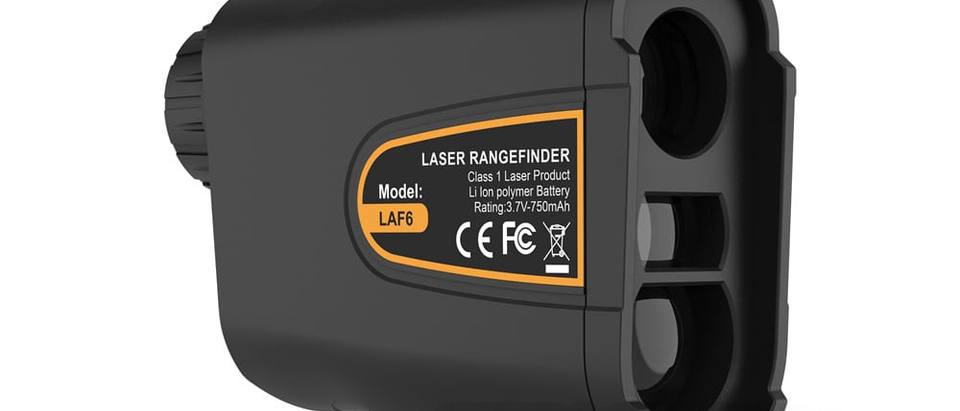
Both of ours are lasers, not GPS. The golf laser rangefinder with flag lock measures from 5 to 600 m, accurate to about 1 m, with 6x magnification and a CR2 battery. The rechargeable LAF6 rangefinder is the smaller of the two, with 6x magnification and a built-in 750 mAh battery. The supplier does not list flag lock or a measuring range for the LAF6.
Our golf rangefinder buying guide explains range, flag lock, slope, batteries and weather in more detail, and you can see both on our golf rangefinders page.
Frequently asked questions
Is a golf GPS watch as accurate as a laser rangefinder?
Not to the flag. A laser measures to the exact object you aim at, and golf lasers commonly quote accuracy of about 1 yard or 1 m. A GPS watch works out your position from satellites and measures to points on a course map, so its number depends on both the satellite fix and how well the course was mapped. It is accurate enough for the front, middle and back of the green, but it does not know where today's flag is.
Are GPS watches allowed in golf competitions?
Yes, in the same way as a laser. Rule 4.3a(1) of the Rules of Golf allows distance and direction information from any device. Features that measure elevation, show plays-like distances or suggest a club must not be used, and a committee can ban all electronic distance-measuring devices with Model Local Rule G-5. Check the Local Rules before the round.
Do golf GPS watches and apps need a subscription?
Some do. Several golf GPS apps give basic green distances for free and charge for extras such as hazard distances or plays-like numbers, and some devices work the same way. Check what the free version includes before you buy. A laser rangefinder never needs a subscription or a map download.
Can I use my phone as a golf GPS rangefinder?
Yes. Many golf apps turn a phone into a GPS rangefinder with front, middle and back distances. Expect the app to use a lot of battery over a round, and switch off any plays-like distances or club suggestions before a round played under the Rules of Golf.