Swing
Golf swing tempo: what it is and how to improve it
What golf swing tempo is, the 3 to 1 backswing to downswing ratio, how to measure your own on a phone, and drills to make your swing smoother at home.
Ask a golfer what went wrong after a bad shot and you will often hear "I rushed it". Tempo is one of the few parts of the swing you can feel, measure and practise without a ball, which makes it ideal for practice at home. This guide explains what tempo is, the ratio that research on tour players found, how to measure your own and the drills that help.
Tempo, rhythm and timing
The words get mixed up, so it helps to separate them. In Golf Digest, coach Jim Flick described tempo as the pace of your swing and rhythm as the order in which the parts of the swing move. He pointed out that one golfer can have a fast tempo and another a slow one, yet both can have the same rhythm.
Timing is the result: the club arriving square at the ball at the right moment. Good tempo and good rhythm make good timing much more likely.
For practice at home, the useful idea is this: you do not need to swing slowly. You need to swing at a pace that is consistent, with a smooth change of direction at the top.
The 3 to 1 ratio
In 2004 John Novosel published Tour Tempo: Golf's Last Secret Finally Revealed, written with John Garrity. By counting video frames of tour players' swings, he found that the backswing took about three times as long as the downswing, a ratio of 3 to 1. The frame counts quoted from the book include 27 frames back and 9 down, 24 and 8, 21 and 7, and 18 and 6.
The total time differs a lot between players. Some take 27 frames to reach the top, others 18. What stays the same is the ratio. Yale physicist Robert Grober has also reported that touring professionals averaged a ratio of about 3 to 1, within a tight range of each other.
For the short game, Novosel's follow-up book Tour Tempo 2: The Short Game and Beyond (2011) describes a 2 to 1 ratio for shots from 60 yards (about 55 m) in.
Two things follow for amateurs:
- Fast or slow is personal. Copying someone else's pace is less useful than finding a pace you can repeat.
- The change of direction is where it goes wrong. A backswing that is too quick, or a downswing that starts with a lunge, breaks the ratio.
Measure your own tempo
You need a phone and a few minutes.
- Set the phone on a tripod or lean it on something at hip height, looking at you face on.
- Film a few normal swings at the standard frame rate (not slow motion).
- Open the video in an app that lets you step one frame at a time.
- Count the frames from the first movement of the club to the top of the backswing.
- Count the frames from the top to impact.
- Divide the first number by the second.
If you get about 3, your ratio is in the range found for tour players. If you get 2 or less, your backswing is quick compared with your downswing. If you get 4 or more, you may be taking the club back very slowly or stalling at the top.
Repeat it every few weeks. The numbers are easier to trust than how a swing feels.
Drills that improve tempo
Count it. Say "one, two, three" on the way back and "four" on the way down, keeping the beats even. The count turns the 3 to 1 ratio into something you can hear.
Use a metronome app. Writing for GOLF.com, coach John Tillery suggests a warm-up with a metronome app set to 65 beats per minute. One simple way to use it: start the backswing on one beat and reach the top on the next. Change the setting until it feels natural, then keep it.
Feet together. Golf Monthly coach Gary Alliss recommends putting your feet together and making your normal full swing. If you swing too fast, you lose your balance. It is a simple, honest test that needs no equipment.
Slow motion. GOLF.com coach Kevin Sprecher recommends slow-motion swings as part of practice. Make a swing that takes ten seconds from start to finish, then five, then normal speed. The slow swings show you where you rush.
Pause at the top. Swing to the top, hold for a second, then swing down smoothly. It stops the downswing starting before the backswing has finished.
Training aids for tempo
A flexible-shaft trainer is built for tempo. The soft shaft bends when you rush the takeaway or snatch the club from the top, and stays loaded when the swing is smooth. Writing in Golf Monthly, PGA professional Joe Ferguson says this kind of trainer takes excellent rhythm and proper sequencing, and will let you know if you are prone to mistakes in transition.
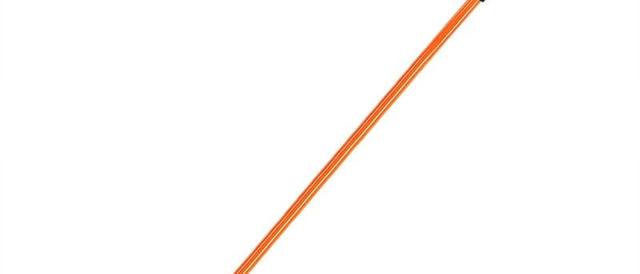
Our flexible-shaft iron swing trainer has a soft orange shaft, an iron-style head and a normal grip, and weighs 520 g. It is made for practice swings, not for hitting balls.
A hinged trainer helps with the other half of the job, holding positions. Our folding hinge swing trainer folds at the joint when the arms or wrists collapse, so it rewards a smooth, unhurried swing. It extends from 79 to 110 cm. Our guide to golf swing trainers compares the types.
A ten-minute tempo session
| Minutes | Drill | Aim |
|---|---|---|
| 0 to 2 | slow-motion swings with your own club | feel each position |
| 2 to 4 | feet-together swings | balance at the finish |
| 4 to 7 | flexible-shaft trainer with a count | shaft stays loaded, no whip |
| 7 to 10 | normal swings with a metronome app | same beat every swing |
Do it before a range session or as a short session on its own in the garden or garage. Check you have room for a full swing above and around you first.
Taking it to the course
- Use the same count for every club. The driver feels longer, but the ratio stays the same.
- Count during your practice swing, then once more in your head as you start the real one.
- Under pressure, think rhythm, not speed. The first tee and the hole after a bad shot are where a familiar count helps most.
Remember that a training aid stays in the bag during a round: the Rules of Golf do not allow it to be used to help you make a stroke. Practise with it at home or on the range, and take only the count to the course. You can see all our swing trainers together.
Frequently asked questions
What is a good tempo for a golf swing?
Research on tour players, popularised in the book Tour Tempo by John Novosel, found that their backswing takes about three times as long as their downswing, a ratio of about 3 to 1. The total speed varies from player to player; the ratio is what stays similar.
What is the difference between tempo and rhythm in golf?
Tempo is the pace of the swing, how long it takes. Rhythm is the order in which the parts of the swing move. Jim Flick explained in Golf Digest that one golfer can have a fast tempo and another a slow one, yet both can have the same rhythm.
How can I improve my golf swing tempo at home?
Practise with a count or a metronome app, make swings with your feet together, add slow-motion swings, and use a flexible-shaft trainer that bends when you rush. Short sessions a few times a week are easier to keep up than one long one.
Should I swing slower to improve my tempo?
Not necessarily. Smooth is not the same as slow. Some good players swing quickly; what good players share is a consistent ratio between backswing and downswing, without a rushed change of direction at the top.