Short game
How to chip in golf: set-up, stroke and drills at home
How to chip in golf: a simple set-up, a putting-style stroke, choosing the club and landing spot, common faults, and chipping drills for the garden or at home.
Chipping is the shot that turns three shots from just off the green into two. It needs no strength, no long swing and very little space, which makes it one of the best things to practise at home. This guide covers a simple set-up, the stroke, choosing the club and where to land the ball, and then a set of drills you can do in the garden or the house.
Chip or pitch?
National Club Golfer puts the difference neatly. A chip is a shot where the ball runs further than it carries and is often played low. A pitch is a shot where the ball carries more than it runs out, generally with a club that has lots of loft.
Choose a chip when:
- the ball is just off the green, in the fringe or light rough,
- there is nothing to carry, such as a bunker or deep grass,
- there is enough green between you and the hole for the ball to roll.
If you need to carry a hazard or stop the ball quickly, a pitch is the better shot.
The set-up
Most of a good chip happens before you swing. Two well-known coaching sources describe almost the same set-up. Paul Foston, a Golf Monthly Top 50 Coach, says to narrow your stance and put about 60 to 65 percent of your weight on your lead side, with the shaft leaning forward a little. National Club Golfer's Jack Backhouse describes the ball fairly back of centre with the hands forward of the ball, creating some forward shaft lean.
Put together:
- Narrow stance, feet a little closer together than for a full shot.
- Weight favouring the lead foot, about 60 to 65 percent, and keep it there.
- Ball slightly back of centre. Not too far back: Foston warns against it.
- Hands just ahead of the ball, so the shaft leans a little towards the target.
- Grip down the handle for control, and stand a little closer to the ball.
The stroke
Think of a putting stroke with a lofted club. Foston describes rocking the shoulders back and through with very little wrist break, and Backhouse says to rock the shoulders while keeping the wrists and arms fairly firm.
- Rock the shoulders, back and through, with the arms and club moving as one unit.
- Keep the wrists quiet. Very little hinge on the way back, no flick on the way through.
- Same length back and through, roughly. A short backswing and a firm finish is better than a long swing that slows down.
- Turn the chest through so the hands stay ahead of the clubhead at impact.
- Hold the finish and look at it: the shaft should still lean towards the target.
Choosing the club
The more loft, the higher the ball flies and the less it rolls. The less loft, the lower it flies and the further it runs. Coaches give rough carry and roll figures, though they do not all agree:
| Club | Rough split according to one GOLF.com Top 100 Teacher | According to a Golf Monthly coach |
|---|---|---|
| Pitching wedge | about one third carry, two thirds roll | about half carry, half roll |
| 8-iron | about one fifth carry, four fifths roll | about a quarter carry, three quarters roll |
Treat these as a starting point. Green speed, slope, grass and moisture all change the roll, so test them on your own course. Many golfers keep it simple: pick the least lofted club that lands the ball safely on the green and lets it roll to the hole like a putt.
Pick a landing spot
Do not aim at the hole. Aim at the spot where you want the ball to land, and let the roll do the rest. Parker McLachlin, writing for GOLF.com, suggests the ball should ideally land one or two paces onto the green, so it can roll like a putt.
Landing on the green, rather than in the fringe, gives you a predictable first bounce. Walk to the landing spot if you have time, look at the slope from there, then choose the club.
Common faults and fixes
| Fault | Common cause to check | Fix |
|---|---|---|
| Fat chip (ground before ball) | weight moving to the back foot, trying to help the ball up | keep 60 to 65 percent on the lead foot through the stroke |
| Thin or skulled chip | flicking the wrists, standing up through impact | quiet wrists, keep the chest over the ball |
| Ball comes up short | slowing down into the ball | shorter backswing, firmer finish |
| No idea of distance | changing club and swing every time | practise with one club and learn its roll |
Chipping drills at home
You do not need a green to practise chipping. You need a short, controlled swing, a target and something soft to hit.
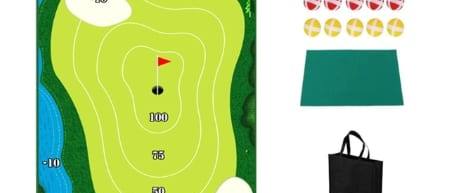
1. The chipping game. Our chipping game mat has a 150 x 80 cm printed target with score zones, a 30 x 20 cm hitting pad and 20 sticky balls. The balls stick where they land, which turns landing-spot practice into a game for the family. Peg it on the lawn or lay it on the floor.
2. The landing towel. Lay a hand towel on the lawn a few paces away and try to land every ball on it. Move the towel closer and further. This trains the landing spot, which is the skill that matters.
3. One club, three distances. With one club, chip to three targets at different distances. Then do it again with a different club and notice how the roll changes.
4. Into the net. A small net with a target gives you a clear aim for low chips and pitches. Our 2 m pop-up practice net has a target sheet on the back panel and a closed base that keeps balls inside.
5. Up and down. In the garden, drop a ball and chip to a marker such as a tee or a coin. Then putt it out on the lawn or on a putting mat. Count how many times out of ten you get down in two.
Safety and space
- Use soft practice balls or sticky balls indoors. Never chip real golf balls in the house.
- Check what is behind and beside your target: windows, the greenhouse, the neighbour's fence.
- Keep children and pets out of the line and away from the swing.
- Use a mat on the lawn so you do not dig holes in it, and on hard floors so the club does not bounce.
Make it a habit
Ten minutes of chipping three times a week is easier to keep up than one long session a month. Combine it with the plan in our guide to practising golf at home in winter, and add a putting mat from our putting green guide so you practise the putt that follows the chip. You will find the chipping game with our other training aids, and the practice net on our golf nets page.
Frequently asked questions
What is the difference between a chip and a pitch?
A chip is a low shot that runs further than it carries. A pitch carries further than it runs and is usually played with a lofted club. Chip when you have little rough to carry and plenty of green to roll on; pitch when you need to carry a bunker or rough and stop the ball quickly.
Where should the ball be in your stance when chipping?
Slightly back of centre, with your hands ahead of the ball so the shaft leans a little towards the target. Do not overdo it: Golf Monthly coach Paul Foston warns against getting the ball too far back.
Should you use your wrists when chipping?
Very little. Coaches describe the chip as a rocking of the shoulders, back and through, with the arms and wrists fairly firm, much like a putting stroke.
Which club is best for chipping?
There is no single best club. A lofted wedge flies higher and rolls less, a pitching wedge or 9-iron rolls further, and an 8-iron or 7-iron rolls further still. Pick the least lofted club that lands the ball safely on the green and lets it roll to the hole.
Can I practise chipping indoors?
Yes, with soft practice balls or sticky balls and a mat, and enough room for a short swing. Never chip real golf balls indoors.